
Fear and Expectation — The 4 Pillars that Elevate Every Dental Consultation (F.A.T.E. Approach)

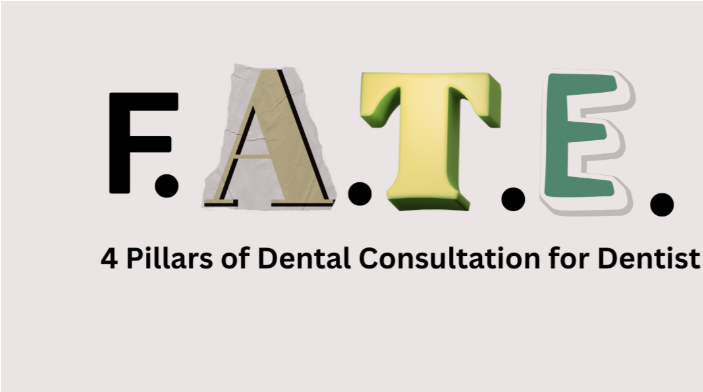
Let me introduce you to a powerful and patient-centered approach to communication during the initial consultation. A moment that often sets the tone for the entire treatment journey. This method focuses on identifying and addressing 4 core areas of concern that typically influence a patient's decision-making and overall experience called the “F.A.T.E”
F - Fear: Anxiety about pain, past trauma, or procedures.
A - Affordability (expenses, payment).
T - Time: Scheduling challenges or fear of long treatment commitments.
E - Expectation: Unrealistic hopes or misunderstandings about results and timelines.

By addressing these elements early on, you lay out the foundation of trust, reduce their anxiety, and guide patients toward informed choices about their dental care. The sooner you identify which of these areas presents the biggest burden for your patient, the more effectively you can respond with tailored communication strategies. In this article, we’ll explore practical tools and techniques to manage each concern, along with real-life dentist–patient conversation scenarios that show how to apply them in a natural, empathetic way.
The first article explores the Fear and Expectation aspect of the ““F.A.T.E”. As dental fear is quite common in the dental environment among the patients, there will be 3 non-sedative management strategies introduced such as Distraction Therapy, Brief Information, and Virtual Reality Exposure Therapy (VRET). In terms of the patient's dental expectations, through real life dentist–patient scenarios, there will be 3 Negotiations techniques discussed to help how to apply these tools in real clinical settings.
Fear

There are 3 main types of non sedative management strategies which will be introduced in this article with some real dentist patient scenarios to explain to the dentist how to handle these cases.
Distraction therapy
Brief information
Virtual Reality
Distraction therapy
Distraction therapy is a widely used approach in dentistry to help patients manage anxiety by redirecting their focus away from fear-inducing stimuli. Techniques such as music therapy and watching television can significantly enhance a patient’s emotional comfort by shifting attention and fostering a more relaxed environment during treatment.
Music Therapy and Its Physiological Impact Music therapy typically involves playing slow-tempo, soothing instrumental tracks—usually around 60 to 80 beats per minute—to calm patients during dental procedures. Studies have demonstrated that this type of music can reduce blood pressure, heart rate, and respiratory rate. By suppressing the sympathetic nervous system, music lowers neuromuscular tension and alleviates anxiety. Using headphones enhances this effect by not only delivering calming sounds but also blocking out unpleasant noises like dental drills.

Based on my experience, patients who engage in music therapy, whether by listening to the provided tracks or their own music and podcasts, often report less discomfort, improved tolerance of treatment, and a greater willingness to return for future dental care. Interesting research from Aravena P. et al. (2020) [2] highlights that different musical frequencies can influence anxiety levels and physiological responses. For example, music played at 432 Hz is considered more neutral and emotionally calming than the standard 440 Hz.
Additionally, many dental clinics offer patients personal comfort items, such as stress balls or familiar objects, to help them regain a sense of control during treatment, further reducing anxiety.
Scenario 1: Nervous Child with Parent Present
Context: A young patient (age 9) is shaking, and their parents are watching with concern.
Dentist (kneeling to the child’s level, speaking softly): "Hey buddy, it looks like this chair feels a little big and scary, huh?"
Child (nods silently)
Dentist (smiling gently): "That’s totally okay. A lot of kids feel this way. We’re just going to count your teeth today. No poking, no surprises—just counting." (Simple, clear explanation)
To the parent (calm tone): "You’re welcome to sit here and he could sit on your lap. (Building trust through inclusion)
To the child (offering control): "Would you like to watch cartoons on TV while we count your teeth, or hold this squishy ball while we work?"

Brief Information to Reduce Anxiety
Many patients become anxious due to a loss of control or lack of understanding during treatment. Providing clear, brief information—both verbal and written—can ease these fears. Cabbar et al. (2019) [3] found that patients who received written information before oral surgery experienced less intraoperative anxiety, even if their initial levels of anxiety were unchanged. Similarly, Tang et al. (2015) [4] showed that dental health instructions before treatment reduced pressure and stress in anxious patients with acute pulpitis. This suggests that early communication regarding procedures and expectations can improve cooperation and patient comfort during treatment.
Scenario 2: Adult Patient Nervous About Extraction
Context: A middle-aged patient is scheduled for a tooth extraction. They’re sweating and breathing rapidly.
Dentist (leaning forward, slow-paced speech): "It sounds like you're really worried about the extraction today." (Labeling and mirroring their emotion)
Patient: "I’m terrified, honestly. I hate needles. I hate all of it."
Dentist: "I hear you. A lot of patients feel exactly like that before an extraction—it’s nothing unusual." (Normalizing the anxiety)
Dentist (calibrated question): "What’s the part that worries you the most—numbness, the sound, or not knowing what’s happening?"
Patient: "Not knowing, mostly."
Dentist: "Thank you for sharing that. I’ll walk you through every step and check in with you often. You’re not doing this alone." (Restoring sense of safety)
Dentist (adding a choice): "Would you prefer I narrate everything or keep it quiet unless something changes?"
Even the simplest technique: mirroring - one of my favorites inspired by Chris Voss [5] could reveal what the patient’s most fearful aspect is during the clinical time.

Virtual Reality Exposure Therapy (VRET)
Virtual Reality Exposure Therapy (VRET) represents a modern cognitive-behavioral approach to treating dental phobia. It allows patients to confront and gradually desensitize themselves to feared dental scenarios in a virtual setting. This method offers a less intimidating alternative to in-person exposure by reducing anticipatory anxiety and making the treatment experience feel safer and more private. Studies suggest VRET can be equally or even slightly more effective than traditional exposure therapy for general anxieties, though its application in dentistry still requires further validation [1].
Expectation

The key to understanding what the patient expects from the dentist and what the patient's current health condition requires might be 2 different things. Nowadays, patients are influenced by Social Media and celebrity culture. This creates unrealistic expectations about achieving perfectionism and instant results. Moreover, dental visit triggers anxiety or past trauma which hinder their ability to understand the biological, technical and timed based limitation of dental procedure.
Initial consultation with the patient is like judo, it is Japanese for a “gentle way”. The philosophy of this sport is to redirect the opponent’s energy to throw or pin. Do not force the opponent in any direction, let them use their own energy and navigate the conversation to your objectives. Therefore, the control during the first conversation is based on the “listener” alias the dentist. While the patient as a “talker" releases their concerns, anger, and frustration, if you are trained well, you will be able to lead the conversation. Observing never absorbing those emotions.
When the patient gets emotional, attacking verbally or blaming you, “bite your tongue”, pause and try to take a deep breath - It is NOT ABOUT YOU - It is about the patient. They might look for someone to blame, they are frustrated by others, or just anxious and they do not know how to handle it. Let them express themselves as the more they talk, the more information they will reveal. Let’s see 3 basic negotiation techniques : which could help to understand the patient’s needs [5].
Intentional listening
Empathic engagement
Guided questions
A. Intentional listening

The first step is to start observing the non verbal communication style (see previous article about Decode Anxiety in the Chair: A Non-Verbal Guide for Dentists) and listening to the patient carefully. Also, the following inside questions are examples which you could use to identify not only patient attitude but unconscious behavior towards dentistry:
When was the last time they have been seen by your dental colleagues?
Where did they get this information which you referred to recently?
Why does the patient have a certain emotion as they are talking to you?
How regularly the patient attends the regular check up and scale & polish will tell you the patient’s current attitude and motivation to dental treatment. Demonstrating your point by using simple terminology and examples which will clarify it to the patient. For example:
“You will not go to IKEA to buy the desired furniture and when you bring it home you might realise that the place is not only filthy but there is not even a space for it.” (IKEA will refund the items..)
Also, there are some patients who visited multiple dentists and they were never ever satisfied with the result and they want YOU to fix it. Watch out as there is a challenge and sometimes there is a trap.
Anchoring to the patient that there is a difference between the social media’s influence and POTENTIAL treatment - based clinical diagnosis (data) is essential [6]. As a patient could be influenced by family, friends, try to figure out where their idea comes from? Many patients reported to me that in the photos their smiles look different than before or less attractive when they compare themselves to others. Since the pandemic patients are spending a lot of time on online meetings so they are more aware of their facial appearance than before.
Many patients only want to be heard, get some positive reassurance or look for professional options. On the other side many of them are overwhelmed, ashamed, anxious so the easiest way to let them talk. While you are listening, remove the mask from your mouth to make sure the patient can see your facial expression. Make eye contact and nod occasionally and slightly lean forward. This body posture should demonstrate engagement to the conversation. If something bothers them the most, they will keep repeating it therefore you could find the pattern. The most common issues are the fear of pain, appearance, functional problems or finances (see it later).

B. Empathic engagement
Once the conversation turns to you, always start with an empathic statement.
“ I can see how important this is to you, and I will do my best to help you. Let’s go through what’s possible step by step so you feel fully informed after I completed the examination”
“It’s clear you’ve put a lot of thought into this, and I respect that. Let’s walk through the options together so we can align your expectations with your current condition of your dentition”
“I understand you were hoping for a quicker result, it’s completely natural to feel that way. Let’s talk about what’s realistically possible and how we can achieve that.”
In dentistry, empathic engagement is the ability to comprehend a patient's feelings and state of mind during a conversation while simultaneously identifying the underlying issues that are causing those emotions. You will be able to increase trust and to guide the conversation in the direction of cooperation. It assists you in recognising emotional obstacles as well as the most effective strategy for leading the patient to realistic, well-informed decisions regarding their care.
Let’s see a couple of examples: Once you observe the patient’s emotion, LABEL it loud.
Using the phrases:
It seems like…
It sounds like….
It looks like…..

Scenario 3: First Visit, Patient Very Anxious
Patient: P
Dentist: D
P (nervous, avoiding eye contact): "Sorry if I seem on the edge... I just really hate coming to the dentist."
D (calm, empathetic tone): "It sounds like being here is really uncomfortable for you."
P (hesitant): "Yeah... I just don’t like it. Bad memories, I guess."
D: "It seems like you’ve had a difficult experience in the past—maybe with another dentist?"
P (pauses, then nods): "Yeah... when I was younger. The dentist didn’t listen, and it hurt a lot. Since then, I just avoid it unless I absolutely have to go."
D: "I’m so sorry that happened to you. No one should ever feel ignored or hurt like that during treatment. It makes complete sense that you'd carry that with you."
P (softens): "Exactly. I just felt like I didn’t matter. And honestly... I haven’t trusted dentists since."
D: "Thank you for trusting me enough to share that. It sounds like you’ve had to carry a lot of anxiety alone. I want you to know, we’ll go at your pace, and I’ll explain everything step by step so you always feel in control. Would that be okay?"
P (relieved): "Yes… that would help a lot."
It is important to build gradual trust with patients who had past negative trauma. Based on my experiences those patients are sometimes tough to handle but they could become not only one of your best “PR managers” in the future but also it could feel real reward to you helping another person to overcome a difficult obstacle in their life.
Scenario 4: Post-Extraction Pain & Miscommunication
Patient: P
Dentsit: D
P (frustrated and loud): "This is ridiculous! You pulled my tooth, and now I’m in more pain than before. What kind of job did you even do? You need to fix this now!"
D (staying calm and composed): "It sounds like you're in a lot of pain and really frustrated with how things have turned out."
P (still angry): "Of course I’m frustrated! I trusted you to fix it—and now it feels worse."
D: "It seems like you feel let down by the whole experience. I’m really sorry you’re going through this right now. That’s not the outcome either of us wanted."
P (breathing heavily): "Yeah, well, I shouldn’t have to deal with this after seeing a professional."
D (gently): "I hear your concerns. And I want to help now. Would it be okay if we go over what’s happening now, and also take a look at how the area is healing? That way, we can figure out the right next step."
P (reluctantly calming): "Fine. But it still hurts like hell. Do not make it worse again"
D: "I understand. It sounds like the pain’s really affecting your day-to-day life. Just to clarify, were you able to follow the post extraction care steps we discussed, like avoiding smoking?"
P (pauses, defensive): "Not exactly. I thought it would be fine. I am in pain of course I am smoking"
D: "It sounds like you were hoping the healing would go smoothly without following the after care protocols which is totally understandable. Let’s take a look now and talk through how we can get you out of pain and back on track."
What the Dentist Did Well
Acknowledged emotion without judgment.
Used labeling to reflect what the patient feels (“It sounds like you're frustrated…”).
Added gentle accountability with calm questioning.
Shifted focus to solutions without escalating conflict.
When facing a patient who is emotionally overwhelmed, a calm and composed presence is essential. A dentist’s steady voice, relaxed posture, and open body language send a strong nonverbal message of safety and control. One of the most effective ways to respond is by labeling the patient’s emotion—making a neutral, nonjudgmental observation such as “It sounds like you’re feeling frustrated.” It’s important not to take their reaction personally or see it as a direct attack on your professionalism.
In moments of distress, patients are often led by emotion, not logic. By gently naming what they may be feeling, the dentist helps the patient step outside their emotion, reducing its intensity or giving them permission to express it aloud. This technique shifts the conversation toward understanding, and patients are more likely to respond thoughtfully—beyond just “yes” or “no”—opening the door to more meaningful dialogue and cooperation.
C. Guided questions

Starting with
In emotionally charged conversations, guided questions ( “calibrated questions”)[5], especially those starting with “How” or “What”, can shift patients from a victim or blaming mindset into a more active, problem-solving one. This approach empowers them to reflect, express their needs, and contribute to finding solutions. Often referred to as the “illusion of control,” guided questions make patients feel heard and involved while allowing the dentist to steer the conversation toward solution.
The power lies in the design: you convey that you want the same outcome but need their input and perspective to make it possible.
This method reduces resistance, builds trust, and leads to more productive dialogue.
How can I help you today?
What is your main concern?
What do you hope to accomplish by leaving the surgery right now?
How am I supposed to do that if I do not know which type of medication you are taking?
What outcome are you looking for?
Scenario 5: Patient Refuses X-rays
Patient: P
Dentsit: D
P (defensive): "I don’t want any X-rays. They’re dangerous, and I’ve already had some this year."
D (gentle tone, leaning slightly forward): "It sounds like you’re concerned about being exposed to more radiation."
P: "Yes. I don’t want to take unnecessary risks."
D (using calibrated questions):
{1} "What do you think would happen if we skip the X-rays and there’s something we miss?" {2} "How would you like me to make the most informed decision about your treatment without that information?"
P (pauses): "I guess I didn’t think about that part…"
D: "There might be a solution to ask the previous dentist to send over the clinical radiograph and their finding however it might not give accurate diagnosis to your current situation"
The patient enters the conversation defensive and fearful, likely due to prior exposure to health warnings or misinformation. Their emotional response is rooted in fear of radiation and a desire to protect themselves, leading them to reject a routine and clinically necessary procedure. Using the labeling and emphatic engagement such as
"It sounds like you’re concerned about being exposed to more radiation."
The dentist acknowledges the emotion without judgment and validates the patient’s concern and lowers their emotional resistance. The tone should be non-confrontational, and body language (leaning forward) communicates active listening and empathy. By introducing guided questions such as engage the patient’s logic while preserving their autonomy:
"What do you think would happen if we skip the X-rays and there’s something we don’t see?"
"How would you like me to make the most informed decision about your treatment without that information?"
Combining the labeling and calibrated questions creates a powerful strategies:
Labeling softens emotional tension by naming the feeling (“concerned about radiation”), which:
Lowers defensiveness
Builds trust
Makes the patient feel seen and understood
Calibrated questions follow naturally, guiding the patient to reflect and make informed decisions.
They shift the mindset from emotional (avoidance) to rational (risk-benefit thinking)
They invite cooperation without pressure
This progression allows the dentist to lead the conversation while making the patient feel that they're in control.
Summary
Managing dental fear without sedation requires more than clinical skill. It demands emotional intelligence, clear communication, and strategic interaction. Through distraction techniques like music therapy and virtual reality, alongside transparent information-sharing and empathic dialogue, dentists can significantly reduce patient anxiety. Real-life scenarios demonstrate how intentional listening, empathic engagement, and guided questions can build trust, defuse emotional tension, and foster cooperative behavior in even the most challenging patients.
In the next article, we will shift focus to the practical concerns of expenses and time, exploring how to align patient expectations with clinical realities in a clear, compassionate, and structured manner.
References:
[1] Hoffmann B et al (2022) - Management strategies for adult patients with dental anxiety in the dental clinic: a systematic review.
[2] Aravena P et al (2020)- Effect of music at 432 Hz and 440 Hz on dental anxiety and salivary cortisol levels in patients undergoing tooth extraction: a randomized clinical trial


